If you’ve been following me for a while, you may remember my original post about glycolic acid as a budget-friendly alternative to Olaplex.
Since then, I’ve done more research and experimented with glycolic acid on my own hair and scalp. What really caught my attention was the research around how glycolic acid can interact with the hair fibre and potentially improve some of the characteristics we associate with damaged, rough or difficult-to-manage hair.
And because I originally bought this product for my acne-prone skin, I already had a giant bottle sitting in my bathroom!
So naturally, I started wondering:
Could the same glycolic acid I was using on my skin also have a place in my curly hair routine?
Here’s what I’ve learned.
Important: Glycolic acid is an acid and should be treated as an active ingredient, not as an ordinary hair conditioner. The results and tolerability can vary depending on your hair, scalp and overall routine.
What Is Glycolic Acid?
Glycolic acid is an alpha hydroxy acid (AHA) that is most commonly associated with skincare.
Its primary function in skincare is exfoliation, which is why you’ll find it in products designed to remove dead skin cells and improve the appearance and texture of skin.
When it comes to hair, however, the conversation gets more interesting.
Research has explored how glycolic acid can interact with the hair fibre and potentially improve properties such as smoothness, manageability and resistance to some forms of damage.
That doesn’t mean glycolic acid is a magic “repair” treatment or that it can reverse every type of hair damage.
But it does explain why some people notice that their hair feels smoother, softer and easier to manage after using it.
Potential Benefits of Glycolic Acid for Hair
Depending on your hair’s condition and how it responds, glycolic acid may help with:
- Reducing tangles by reducing friction
- Improving softness and smoothness
- Increasing shine
- Improving manageability
- Supporting elasticity and flexibility
- Helping hair feel less rough
- Reducing the effects of humidity-related swelling
- Supporting hair that has been exposed to heat, sun or chemical processing
- Reducing the likelihood of breakage associated with rough, damaged hair
And for curly hair, anything that improves slip, softness and manageability can make styling significantly easier.
But is glycolic acid actually a bond repair treatment?
This is where I want to update my original article.
I originally described glycolic acid as a budget alternative to Olaplex because of research suggesting benefits to the hair fibre.
Today, I would be more careful with that comparison.
Glycolic acid and Olaplex are not the same type of treatment and shouldn’t be treated as interchangeable products.
Olaplex is specifically formulated around its bond-building technology, while glycolic acid is an acid that can affect the properties of the hair fibre.
So rather than saying:
“Glycolic acid is a cheaper Olaplex.”
I’d say:
“Glycolic acid is an interesting treatment ingredient that may improve the feel, smoothness and manageability of damaged hair.”
That’s a much more accurate way to look at it.
What About Glycolic Acid on the Scalp?
Glycolic acid is primarily an exfoliating ingredient, so it can help loosen and remove dead skin cells when appropriately formulated for scalp use.
However, I wouldn’t make the claim that exfoliating your scalp automatically means your hair will grow faster.
A clean, healthy-feeling scalp is certainly a good part of overall scalp care, but scalp exfoliation is not a guaranteed hair-growth treatment.
If you’re using glycolic acid on your scalp, remember that you’re dealing with an active acid. More is not better.
If your scalp is sensitive, irritated, broken or already inflamed, I’d skip it.
How Long Should You Leave Glycolic Acid on Your Hair?
In my original routine, I recommended approximately 10–20 minutes.
That’s the window I personally worked with.
However, the correct contact time depends on the specific product you’re using, its concentration and how it is formulated.
Always follow the instructions for the product rather than assuming that every glycolic acid product should be used for the same amount of time.
And please don’t assume that leaving it on longer will give you better results.
With acids, more isn’t necessarily better.
How Often Should You Use Glycolic Acid on Curly Hair?
This depends on your hair’s condition.
When I originally wrote this article, I had relatively healthy hair and could use it approximately once a month.
If your hair has significant heat, colour, bleach or environmental damage, you may be tempted to use a treatment more frequently.
But I would not automatically recommend weekly use just because your hair is damaged.
Start conservatively, observe how your hair and scalp respond, and follow the product’s directions.
If your hair starts feeling dry, rough, brittle or your scalp becomes irritated, that’s a sign to stop and reassess.
Your hair doesn’t need to feel “treated” all the time to be healthy.
Which Glycolic Acid Is Good for Curly Hair?
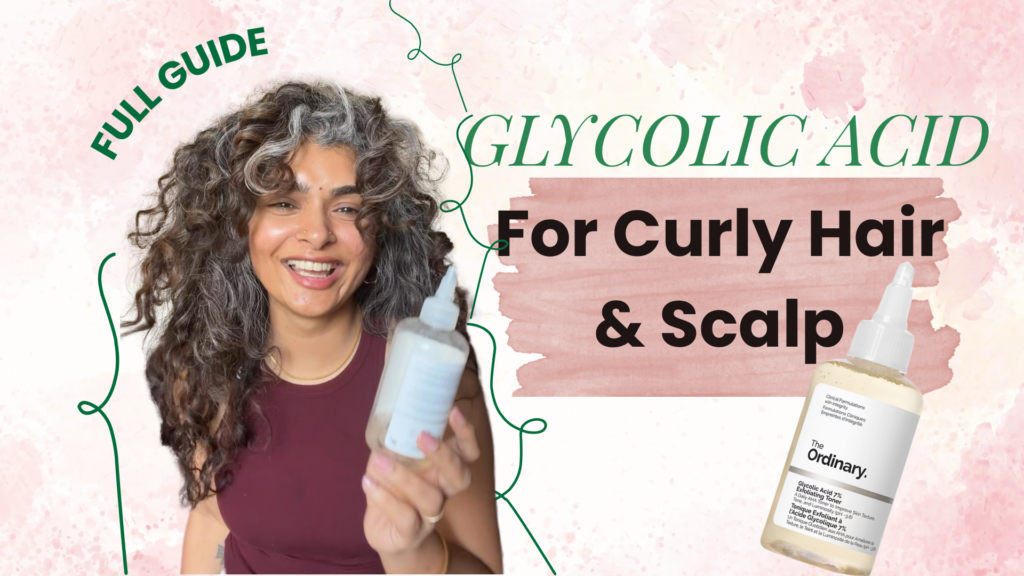
The product I originally used was The Ordinary Glycolic Acid 7% Exfoliating Toner.
I chose it because it was readily available to me, and I already owned it for my skin.
The concentration is 7%, which is within the range I was researching when I originally wrote this article.
However, there is an important distinction:
A skincare glycolic acid product is not automatically a hair product.
If you choose to experiment with a skincare product on your hair or scalp, do your own research, check the manufacturer’s instructions and use your discretion.
For scalp use in particular, I’d be more cautious than I would be with the lengths of the hair.
How Long Does a Bottle Last?
This depends completely on your hair length, density and how frequently you use it.
For me, one bottle lasted a very long time because I wasn’t using it every wash day.
Depending on your hair, a bottle can potentially last many months.
That’s one reason I originally loved the idea of repurposing the bottle I already had.
How I Apply Glycolic Acid to My Curly Hair
I’ve used glycolic acid on both my scalp and curly hair, and I created a tutorial showing exactly how I apply it.
[WATCH MY GLYCOLIC ACID HAIR TUTORIAL]
The key is to work methodically and avoid saturating your hair unnecessarily.
If you’re trying this for the first time, I recommend starting cautiously rather than going all in.
What To Do After Applying Glycolic Acid
What you do after the treatment matters just as much as the treatment itself.
1. Rinse Thoroughly
Start by rinsing your hair thoroughly with lukewarm water.
Make sure you’ve removed the glycolic acid before moving on to your normal wash routine.
2. Shampoo
Follow with your shampoo.
You want your hair and scalp clean and ready for conditioning and styling.
3. Condition and Moisturize
Apply a moisturizing conditioner from your mid-lengths through your ends.
Leave it on for a few minutes so your curls get some much-needed moisture and slip.
4. Detangle Gently
While your hair is coated with product, gently detangle using your fingers or a proper brush.
Don’t rip through your curls just because you’re in a hurry.
5. Rinse
Rinse your conditioner thoroughly.
You don’t need to force your hair to feel “squeaky clean.” Your goal is clean, conditioned and manageable hair.
6. Apply Your Leave-In
Once you’ve rinsed, apply your usual leave-in conditioner if your hair needs one.
Pay particular attention to your ends and any areas that tend to feel drier.
7. Style Your Curls
Now you can continue with your normal curly hair routine.
Apply your styling products, form your curl clumps and either air-dry or diffuse.
If you’re using heat, remember to use appropriate heat protection.
Glycolic Acid Aftercare Based on Your Hair
One thing I’ve learned from working with different curl patterns and textures is that there isn’t one post-treatment routine that works for everybody.
Here’s how I would approach it.
Healthy, Coarse, Thick, Coloured Hair
You may be perfectly happy with:
Shampoo → conditioner → leave-in+cream → gel → style
You don’t necessarily need to pile on five different treatments.
Damaged, Coloured or Bleached Hair
I’d focus more heavily on moisture after shampooing.
A deep conditioning treatment may be useful if your hair feels dry or compromised.
Fine or Low-Density Hair
Be careful about loading your hair with too many heavy products.
You may prefer a lighter conditioning routine and styling products that give you definition without weighing down your curls.
If your hair responds well to protein, you can also incorporate protein-containing styling or treatment products into your routine.
What I Don’t Want You To Do
Please don’t see glycolic acid and think:
“If 7% works, 14% must work twice as well.”
No.
Please don’t start applying stronger acids to your scalp because someone online said it gave them amazing growth.
And don’t assume that because something is marketed for skincare, it’s automatically suitable for your hair or scalp.
Your scalp is skin but a skincare routine and a scalp-care routine aren’t automatically interchangeable.
Patch testing is sensible when introducing a new active ingredient, and if you have a scalp condition, significant irritation or concerns about hair loss, speak with a qualified professional.
My Biggest Takeaway About Glycolic Acid for Curly Hair
I still think glycolic acid is a fascinating ingredient for hair.
What I love most is that it challenges the idea that you need an expensive, complicated routine to experiment with new technology and ingredients.
But I also want to be more responsible with how I talk about it today.
Glycolic acid isn’t a miracle cure for damaged curls.
It isn’t a replacement for every bond-building treatment.
It isn’t a guaranteed hair-growth treatment.
And it definitely isn’t something you need to use just because it’s trending.
Instead, think of it as one possible treatment in your curly-hair toolbox.
Your hair’s condition, texture, density, porosity, colour history and styling routine all matter.
And ultimately, your hair gets the final vote.
Where to Buy The Ordinary Glycolic Acid
I originally purchased my bottle because I was using it for my acne-prone skin.
It became a favourite in my skincare routine, and I was thrilled to discover that there was research exploring its potential use on hair too.
Since then, my Instagram community has shared different places where they have found The Ordinary Glycolic Acid.
Availability changes, so always check the retailer and product listing before purchasing.
Australia
Myer
Adore Beauty
Priceline Pharmacy
Bahrain
Nasser Pharmacy
Canada
Sephora
The Ordinary
Well.ca
Germany
Douglas
Greece
Lookfantastic
Sephora
India
Amazon
Kuwait
Boots
New Zealand
Farmers
Pakistan
DuBuy
Qatar
Sephora
Spain
Sephora
Sweden
Apotek
Singapore
Beauty Bay
Switzerland
Jelmoli
UAE
Amazon
Noon
Cult Beauty
United States
DECIEM
Sephora
Ulta
UK
Boots
Retailers and availability can change, so please verify stock and authenticity before purchasing.
If you know a trustworthy retailer in your country, let me know and I’ll be happy to add it to the list.
Glycolic Acid Alternatives
When I originally published this article, readers in India were sometimes struggling to find The Ordinary Glycolic Acid.
Some alternatives I came across included:
- Eclat
- The Derma Co
- Pixi Glow Tonic
- Minimalist
- Neemli
Important: I have not personally tested all of these products as hair treatments.
Don’t assume that a product is a suitable substitute simply because glycolic acid appears on the ingredient list. Check the concentration, formulation, instructions and intended use before experimenting.
FAQs: Glycolic Acid for Curly Hair
Can glycolic acid help damaged curly hair?
It may help improve properties such as smoothness, softness and manageability, particularly in hair that feels rough or damaged. However, it should not be treated as a magic repair treatment or guaranteed solution for damaged curls.
Can glycolic acid make curly hair softer?
It may. One of the reasons people are interested in glycolic acid for hair is its potential effect on the hair fibre, including improved smoothness and manageability.
Does glycolic acid repair hair bonds?
I would be careful with this wording. Glycolic acid has been studied for its effects on the hair fibre, but it is not the same technology as a dedicated bond-building product such as Olaplex.
Can I use glycolic acid on my scalp?
Some people use glycolic acid as a scalp exfoliant, but you should be cautious. Follow the specific product instructions, avoid irritated or broken skin, and stop if you experience burning or significant irritation.
Does glycolic acid make hair grow faster?
There isn’t enough reason to promise that. Glycolic acid may exfoliate the scalp, but exfoliation does not automatically mean faster hair growth.
How often should I use glycolic acid on curly hair?
Start conservatively. Your ideal frequency depends on your hair’s condition, the specific product and how your hair and scalp respond. I personally used it around once a month when my hair was healthy.
Can glycolic acid cause dryness?
It can. Remember that glycolic acid is an active acid, so overuse or inappropriate use may leave the hair or scalp feeling dry or irritated. That’s why post-treatment conditioning and moderation matter.
Is glycolic acid suitable for all curly hair types?
Not necessarily. Curly hair isn’t one-size-fits-all. Fine, coarse, colour-treated, bleached, low-density and highly porous hair can all respond differently.
The Curly Hair Lesson I Keep Coming Back To
You don’t need to copy someone else’s routine just because it works beautifully on their hair.
That applies to glycolic acid.
It applies to protein, oils, to styling techniques.
Your hair gets the final vote.
Pay attention to how it feels, how it behaves and what happens over time.
That’s how you build a curly hair routine that actually belongs to you.
And if you’re still confused about what your hair needs, that’s exactly why I created my curly hair resources and coaching options below.
Need More Help With Your Curly Hair?
Basic — Curly Hair Products Guide
Ideal if you’re looking for specific, affordable resources to improve your curly hair routine. Includes 67 pages of insights, sample routines and 60+ tried-and-tested products to help you make better choices. Download Now
Premium — Curly Hair 1:1 Coaching
For clients who want personalized guidance based on their own hair, routine and goals. Open worldwide. Calls on Sundays only. Book Now
Your curls don’t need more rules.
They need the right information for your hair.
Love,
Elizabeth Alex