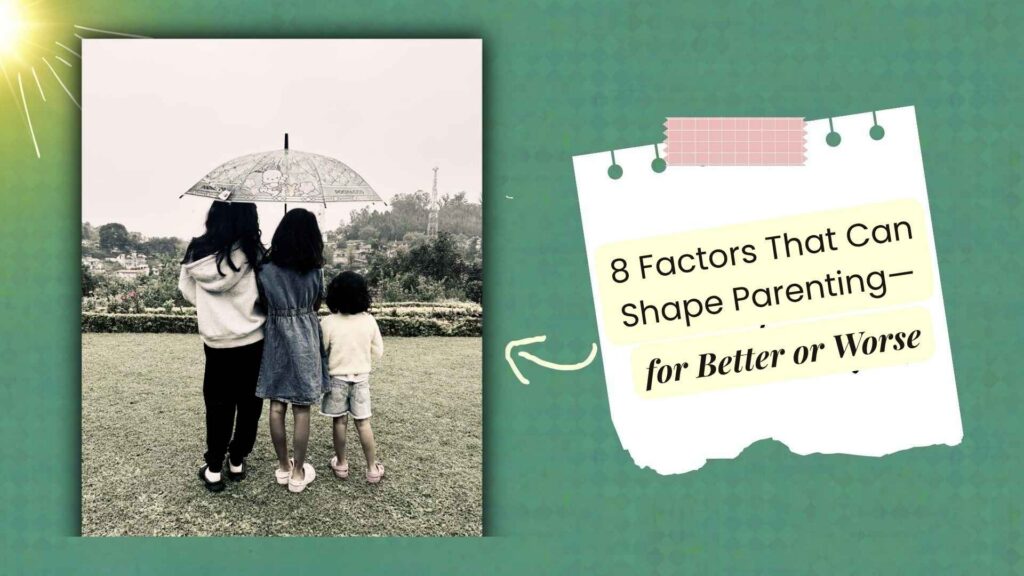
8 Factors That Can Shape Parenting—for Better or Worse
No parent wakes up one morning hoping to hurt their child. Yet many of us grow up carrying wounds from the very people who were supposed to protect us.
As I’ve gotten older, and especially after becoming a parent myself, I find myself asking a different question.
Not… “Why were my parents like that?”
But…“What shaped them into becoming that kind of parent?”
Understanding doesn’t erase the hurt. It doesn’t excuse abuse. But it can replace bitterness with compassion, and that’s often where healing begins.
This article combines what I’ve learned through psychology, my own parenting journey, and years of studying what the Bible says about raising children.
Becoming a Parent Changes Everything
Few life events change you as deeply as becoming a parent. I often say there were two moments that completely changed my life: Finding Christ in my late 20’s and becoming a mother soon after. Both required me to become someone I wasn’t before.
Parenthood isn’t just about being on nippy and nappy duties or surviving sleepless nights. It changes:
- your identity
- your priorities
- relationships
- your finances
- expectations
- your marriage
Many parents are grieving the life they left behind while trying to love the children in front of them. That’s a difficult place to live.
Why Parenting Can Bring Out the Best, and the Worst, in Us
Stress doesn’t create character. It often reveals it.
When children arrive, every weakness becomes more visible. The impatient become shorter-tempered. The anxious become more controlling. The perfectionist struggles when children refuse to fit perfect expectations.
That’s why parenting can feel so exposing.
Eight Factors That Can Influence Parenting
These aren’t excuses. They’re simply realities that can shape how we respond to our children.
1. Your Experience of Pregnancy
Every pregnancy is different. Some women love being pregnant. Others count down the days until it’s over. Some pregnancies are carefully planned and celebrated. Others come as a complete surprise. Some are marked by fear, illness, loss, or complications. All of these experiences can influence how a parent adjusts after the baby arrives.
For me, pregnancy was incredibly difficult. I had severe morning sickness; not just in the mornings, but all day, every day, for all nine months of each pregnancy. And I went through it with all three of my children.
Did that mean I loved my children any less? Not at all. But it did mean I began motherhood physically and emotionally depleted.
Looking back, I have so much compassion for mothers who have difficult pregnancies. When you’ve spent months battling sickness, pain, anxiety, or complications, you’re already carrying a heavy load before your baby even arrives.
That’s why I believe we should be slow to judge new parents. You never know what they’ve already endured.
Pregnancy doesn’t determine what kind of parent you’ll become. But it can influence how much support, rest, encouragement, and grace you’ll need during those first months of parenthood.
And there’s no shame in needing help. Sometimes the strongest thing a parent can say is, “I’m struggling.” That’s often where healing, and healthier parenting, begins.
2. Unmet Expectations
Sometimes the biggest adjustment isn’t becoming a parent. It’s realizing that every child is completely different.
My first daughter made motherhood feel… easy. She slept well, settled into routines naturally, and many parts of parenting came instinctively with her. Looking back, I almost became overconfident. I thought, “I’ve got this.”
I loved being a mother so much that I wanted another baby almost immediately. Then my second daughter arrived. She completely changed my understanding of parenting.
She was deeply attached to me from the beginning. She wanted to be close to me almost all the time. She breastfed much longer than my first child, and she slept in our bed until she was around six years old because that’s what helped her feel safe and secure.
At first, I kept wondering, “Why isn’t this working? This worked perfectly with my first child.” Then I realized something that changed my parenting forever: The problem wasn’t my daughter. The problem was my expectation that she would be like her sister.
She wasn’t. She didn’t need the same routine nor the same approach. She needed a different mother, one willing to adapt instead of expecting her to fit a system that worked for someone else.
That lesson has stayed with me through all three of my children.
Each child has their own personality, strengths, fears, and emotional needs. What brings one child comfort may overwhelm another. What motivates one child may discourage another.
Good parenting isn’t about treating every child the same. It’s about learning each child well enough to give them what they need. Love Languages of Children is a great read!
As parents, we often spend so much time trying to change our children. Sometimes God is using our children to change us. I remind myself everyday, children aren’t projects. They’re people.
Learning to release expectations is one of parenting’s greatest lessons.
3. Emotional Readiness
Age doesn’t automatically make someone emotionally mature. I’ve met parents in their twenties who parent with incredible patience and wisdom. I’ve also met parents in their sixties who are still emotionally reactive. It’s less about your age and more about your willingness to grow.
When I became a mother in my twenties, I was still growing up myself. I loved my children deeply, but looking back, I can see how much emotional growing I still had to do. I was learning how to regulate my own emotions while trying to teach tiny humans how to regulate theirs.
Now, in my forties, something has shifted. I’m calmer, more grounded. Not because life is easier—it certainly isn’t—but because I’ve learned where to take my worries.
Before I respond to my children, I often need to spend time in prayer first. Prayer has become one of the greatest parenting tools I have.
It reminds me that my children ultimately belong to God before they belong to me.
“All your children will be taught by the LORD, and great will be their peace.” — Isaiah 54:13
It softens my heart, gives me wisdom when I don’t know what to do, and helps me respond instead of simply reacting.
One lesson parenting has taught me is that you never stop learning. The parenting skills that worked beautifully with my toddlers didn’t work with my tweens. The conversations that helped my tweens don’t always connect with my teenager today.
Every season asks something different of us. Our children keep growing. Which means we have to keep growing too. That’s one reason I still read parenting books, study Scripture, talk with other parents, and ask God daily for wisdom.
Parenting isn’t a skill you master once. It’s a lifelong process of learning, adjusting, apologizing when necessary, and becoming a little more like Christ along the way.
“If any of you lacks wisdom, let him ask God, who gives generously to all without finding fault, and it will be given to him.” — James 1:5
That verse has become one of my greatest comforts as a parent. Because no matter how old we are, we’ll never outgrow our need for God’s wisdom.
4. Financial Pressure
Children bring incredible joy. They also bring new responsibilities. Hospital bills, school fees, growing grocery lists. Unexpected emergencies.
Financial pressure can increase anxiety, create conflict between spouses, and leave parents emotionally exhausted.
Sometimes the stress isn’t the child. It’s everything surrounding the child.
For me, though, this has also been one of the greatest places where I’ve seen God’s faithfulness. Every time we welcomed another child into our family, people asked the same question:
“Can you afford another baby?” The honest answer? Looking at our bank account alone, probably not. But looking back over the last decade, I can say this with complete confidence: God has always provided what we needed. We’ve always had food on the table, clothes to wear, a roof over our heads.
Our needs have been met again and again. That doesn’t mean life has been luxurious. Far from it.
There were seasons when every expense had to be carefully considered. We’ve had to make sacrifices. We’ve said no to many things the world considers normal.
I’ve never believed my children needed expensive holidays every few months or designer clothes or the newest gadgets nor constant entertainment.
Becoming a parent completely changed how I viewed money. Instead of asking, “What do I want?” I began asking, “What does my family truly need?”. That simple shift changed everything.
Parenthood taught me to budget more carefully, spend more intentionally, and be content with less.
Jesus said, “Seek first the kingdom of God and His righteousness, and all these things will be added to you.” — Matthew 6:33
I’ve seen that promise play out in my own life. Not because every desire was fulfilled. But because every genuine need was met. That’s why when people tell me,
“I’m waiting until I have a bigger bank balance before having children,”
I gently encourage them to examine what’s driving that decision. For some families, waiting may be wise. For others, fear of the future can become a prison. Each family must prayerfully seek God’s wisdom for their own circumstances.
My testimony is simply this: When God called me into motherhood, He also taught me how to trust Him more deeply. Not only for finances… but for wisdom, provision, contentment and daily bread.
Because sometimes the greatest miracle isn’t that your income increases. It’s that your heart learns the difference between what you want and what you truly need.
5. Lack of Support
Parenting was never meant to happen in isolation. One of the biggest lies modern parents believe is: “I should be able to do this on my own.” The truth is, raising children has always been a community effort.
When one parent carries every responsibility, whether physical, emotional, spiritual, or financial – burnout is never far behind.
I’ve experienced seasons where most of the responsibility for raising my children rested on my shoulders. I was thinking about everything. School, Meals, Church, Activities, Doctor’s appointments, Homework, Discipline, Character. Their relationship with God.
It wasn’t just the practical responsibilities that were exhausting. It was the mental load of constantly thinking ahead.
Parenting can become very lonely when you feel like you’re carrying it alone. That’s why I’ve learned that community isn’t a luxury. It’s one of God’s gifts.
Over the years, I’ve intentionally surrounded both myself and my children with people who share our faith.
Joining Bible Study Fellowship (BSF) has been one of those gifts. One of the things I love most is that my children and I are often studying the same passages of Scripture during the week. It gives us natural conversations around the dinner table and reminds us that we’re growing together, not separately.
Our local church, women’s Bible studies, children’s ministries, and Christian friendships have all become part of the support system God has graciously provided. Those relationships don’t replace parents. But they strengthen parents. They remind us we’re not carrying this responsibility alone.
The Bible paints this picture beautifully:
“And let us consider how we may spur one another on toward love and good deeds, not giving up meeting together… but encouraging one another.” — Hebrews 10:24–25
I’ve found that to be just as true in parenting as it is in every other area of life. Sometimes the greatest gift you can give your children isn’t another activity or another toy. It’s allowing them to grow up surrounded by wise, godly people who will encourage them, pray for them, and point them toward Christ alongside you.
Because children don’t just learn from their parents. They learn from the community their parents choose.
6. Childhood Wounds
Many parents unconsciously repeat what they experienced growing up. Others go to the opposite extreme, trying so hard not to become like their parents that they create different challenges of their own. I believe healing begins when we become aware of those patterns.
Growing up, my parents rarely spoke with me in the way I longed for. There weren’t many deep conversations. There wasn’t much physical affection either. I don’t remember feeling emotionally known in the way I hoped for as a child.
For many years, I didn’t realize how deeply those experiences had shaped me. Then I became a mother.
Almost instinctively, I found myself doing the opposite. From the day my children were born, I talked to them constantly. Even before they could understand my words, I explained what I was doing. I described the world around them. I told them why we were doing things.
As they grew older, those little conversations became deeper discussions about life, faith, friendships, fears, mistakes, and the choices they were facing.
I wanted my children to know something I often questioned growing up: “Your thoughts matter.”
Today, one of the things I love most is that my children have opinions of their own. They ask thoughtful questions. Sometimes they even challenge me. And honestly? I love that. It doesn’t mean we always agree. But it tells me they feel safe enough to think, speak, and be heard.
Looking back, I realize that one of God’s greatest gifts is His ability to redeem our past.
Not every painful experience has to be repeated.
Sometimes our deepest wounds become our greatest teachers. Not because the hurt was good… but because God can use it to shape us into different parents.
I’ve often thought that parenting isn’t only about teaching our children. Sometimes our children reveal the places in our own hearts that still need healing. When we invite God into those places, the cycle can change. The patterns can be broken. And a new legacy can begin.
As Paul reminds us:
“Do not be conformed to this world, but be transformed by the renewing of your mind…” — Romans 12:2
That renewal doesn’t happen overnight.
For me, it’s been happening one conversation, one prayer, and one act of grace at a time.
Because healing isn’t about pretending your childhood didn’t affect you. It’s about allowing God to decide how your story continues..
7. Personality Differences
Some children are naturally easy-going. Others are highly sensitive, energetic, independent, or strong-willed. None of those personalities are wrong. They simply need different parenting approaches.
One child may respond well to gentle encouragement. Another may need clearer boundaries. A third may need extra reassurance before they feel safe enough to try something new.
The mistake many parents make is expecting every child to respond the same way. They won’t.
As an elder millennial, I also recognize that my parents were raising children in a very different world. They didn’t have the community we have today. They didn’t have access to parenting podcasts, online courses, research articles, YouTube tutorials, or thousands of books explaining child development. Many parents simply did the best they could with the knowledge they had.
I’m grateful for that perspective because it helps me extend grace toward the generation before me. At the same time, I don’t believe we’re called to repeat everything we experienced simply because, “That’s how it was done.”
We have more knowledge today, more resources, more opportunities to learn. The real question is: Are we willing to grow?
Every generation has a choice. We can continue parenting the way we were parented… Or we can humbly keep learning, adapting, and asking,“What does my child need from me in this season?”
For me, one of the greatest gifts God has given us is the ability to keep growing. I still read books, listen to wise parents, study Scripture. I still ask questions. Because my children are changing every year. That means I need to keep changing too.
Good parenting isn’t about knowing everything. It’s about remaining teachable.
“Let the wise listen and add to their learning, and let the discerning get guidance.” — Proverbs 1:5
I pray that’s the kind of parent I continue to become.
8. Chronic Stress
Sleep deprivation, marriage struggles, work pressure, health concerns, unresolved grief. Over time, chronic stress changes how we speak, listen, and respond to the people we love most. Children are often the safest people in our lives. Sadly, that also means they sometimes receive the leftovers of our energy.
I remember one particular season of my life when I was trying to do everything. I was running my business by myself; creating content, packing every order, answering customer service messages, managing this website, looking after the house, meals. Taking the children to their activities.
Trying to be present. Trying to keep everyone happy. By the end of the day, I had nothing left.
One of our favourite bedtime traditions was reading together every night. The children would bring me their books, excited to hear another story. But there were seasons when I would simply say, “Not tonight. I’m so tired. Let’s just go to bed.”
At the time, it felt like such a small decision. Today, when I look back, those are some of the moments I grieve most. Not because my children suffered. In fact, quite the opposite.
I’m so thankful they grew up loving books. Today they read constantly on their own, and I praise God for that. But I still wish I had been more present during those bedtime moments.
That season taught me something important. You cannot pour into your children from an empty cup forever. Eventually, something has to change.
For me, that meant learning to manage my time differently. I started scheduling my work instead of letting my work schedule me. I began protecting my rest instead of treating it like a luxury.
I learned to work more intentionally during the weeks when I naturally have more energy, and to slow down when my body needs recovery.
As a woman, paying attention to my cycle has helped me recognise when to push forward and when to rest. That rhythm has made me a more patient mother. A more present mother.
Not because life suddenly became easier. But because I stopped expecting myself to live at full speed every single day. Jesus Himself often withdrew to quiet places to pray and rest (Luke 5:16). If the Son of God made space for rest, perhaps we should too.
I’ve realised that being constantly busy isn’t a badge of honour. Presence is. Our children may not remember every toy we bought them. But they’ll remember whether we were truly with them.
Sometimes the most loving thing we can do for our family is to care for ourselves well enough that we still have something meaningful to give.
Are Mothers Better Parents Than Fathers?
I don’t believe the answer is yes. Or no. I think the better question is: Are both parents fully engaged?
Throughout Scripture, God repeatedly addresses parents, not just mothers or fathers.
Children flourish when both parents participate. Not because each parent does the same thing. But because each brings different strengths.
What the Bible Taught Me About Parenting
One verse changed how I speak to my children.
“Fathers, do not provoke your children, or they will become discouraged.” — Colossians 3:21
That verse isn’t only for fathers. It’s a warning for every parent. Children don’t grow through constant criticism. They grow through consistent instruction, loving correction, and grace.
Another verse that has stayed with me is Proverbs 22:6. Training a child isn’t only about today’s behaviour. It’s about preparing them for adulthood. Every conversation, habit, apology, every prayer. They all matter.
What Changed in My Own Parenting
When I first became a parent, I thought good parenting meant having all the answers. Now I think it means being willing to keep learning.
I’ve apologised to my children, changed routines and adjusted expectations. Asked God for wisdom more times than I can count. Parenting has humbled me more than anything else.
Healing Doesn’t Always Mean Blaming
One of the hardest lessons I’ve learned is this: You can acknowledge your childhood wounds… without letting them define the rest of your life.
Understanding your parents’ struggles doesn’t erase what happened. But it may help you stop carrying it forever.
Final Thoughts
You may not have chosen the family you were born into. But you do have a choice about the family you’re building. Every generation has the opportunity to stop unhealthy patterns. Not through perfection but through humility, grace, repentance. And daily dependence on God.
That’s the kind of parent I’m still learning to become.
Frequently Asked Questions
Usually it’s not one single factor. Stress, unresolved trauma, unrealistic expectations, poor emotional regulation, and lack of support can all influence parenting.
Yes. Self-awareness, counseling, healthy community, and spiritual growth can all help parents develop healthier relationships with their children.
No. Understanding brings compassion, but it doesn’t remove responsibility or accountability.
Scripture encourages parents to teach, guide, discipline with love, and avoid provoking or discouraging their children (Proverbs 22:6; Colossians 3:21; Ephesians 6:4)