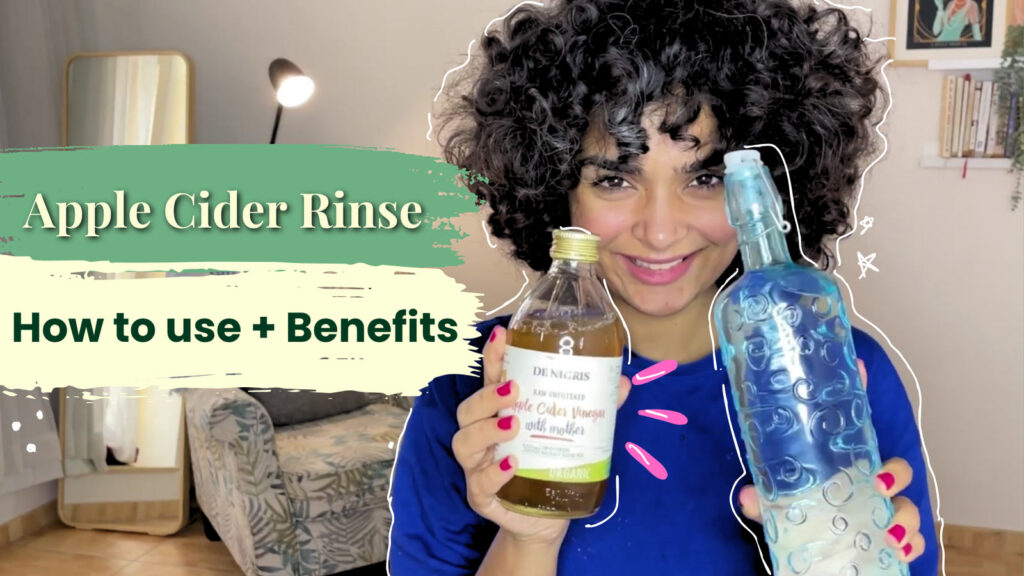
Apple Cider Vinegar (ACV) rinses are a quick, natural, and affordable way to get shiny, healthy curls.
As the name suggests, ACV is made from crushed apples, yeast, and sugar, fermented to create a nutrient-rich vinegar. Depending on how you use it, this simple rinse can detox buildup and hard water residue from your hair.
Review Summary
| Product | What it does well | How it feels | Key ingredients | Does it have protein? |
| DIY ACV Rinse for curly hair | Clarifies scalp, removes buildup, adds shine, balances pH, reduces frizz | Watery, light, may smell acidic but rinses clean | Apple cider vinegar (fermented apples), and water (diluted) | no* |
*ACV rinse helps in pH balancing, scalp clarification, cuticle sealing, and shine, not in rebuilding or strengthening the hair shaft like protein treatments do.
Benefits of
ACV for Curly Hair
- ✅ Stimulates hair growth
- ✅ Detangles curls
- ✅ Prevents split ends
- ✅ Reduces frizz
- ✅ Balances your hair’s pH
- ✅ Great as a final rinse to close cuticles and reduce porosity.
- ✅ Works for all porosity levels but especially beneficial for high porosity hair.
- ✅ No heavy feel, does not weigh down curls.
- ✅ Affordable, natural alternative for scalp health and shine.
Why try ACV Rinse Before Styling Your Curly Hair?
ACV rinses are typically used as a final rinse before styling.
They help close the cuticles and can lower your hair’s porosity, especially beneficial if you have high-porosity hair. Lower porosity means your styling lasts longer. And you don’t need as many products to maintain moisture and balance in your curls.
How I Do the ACV Rinse
I use ACV rinses to refresh my hair on day 3.
- Rinse hair with warm water to remove old product.
- Dip hair into a bowl of warm water mixed with 1–2 tbsp ACV.
- Keep for 3 minutes, massaging the scalp.
- Rinse with cold water.
- Deep condition and style as usual.
Note:
- For fine or wavy hair, you can do this before conditioning or styling.
🎥 Watch a quick tutorial here: pH Value of Hair, and How Acids help!
Does ACV Work Like Shampoo?
I asked @TheMestizaMuse this exact question:
“ACV can interrupt some oil but not like shampoo. Shampoo can fully remove oil due to surfactants, while ACV is great for pH balance but not strong enough to remove silicones or polyquats. It helps with some buildup but won’t replace clarifying shampoos.”
If you need to fully clarify your hair, use a clarifying shampoo occasionally.
Avoid These Rookie Mistakes
❌ Don’t use filtered ACV; use raw ACV with the “mother.”
❌ Don’t leave it on too long to avoid dryness.
❌ Avoid overuse; limit ACV treatments to once a week.
✅ Deep condition after your rinse if you have coarse, thick hair.
✅ Style directly after if you have fine or wavy hair.
✅ Rinse it out completely.
Why Try an ACV Rinse?
ACV is an all-natural, SLS-free way to deep-clean your hair and scalp.
Try it if you struggle with:
- Dandruff
- Psoriasis
- Eczema
- Dry, lifeless curls that won’t clump or respond to products
- Hair loss and allergy from using commercial shampoos
- Hair color or bleach
Doing an ACV rinse just once or twice a month can revive dull hair.
That’s it! No wait. Remember, it’s ACV, not AVC. ♥️
Thank you for watching and reading.