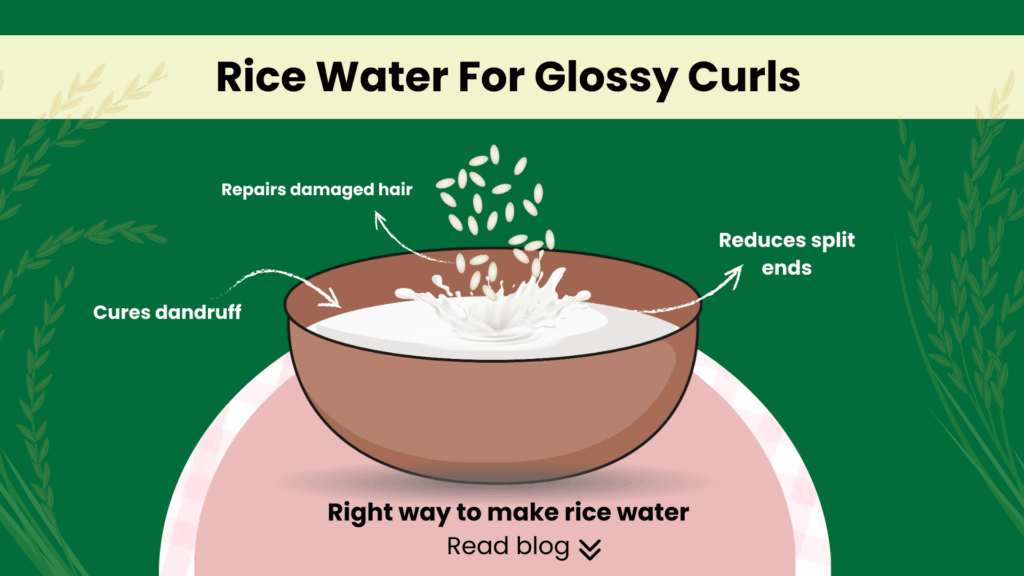
Did you know rice water rinses can strengthen hair, add shine, boost growth, and improve clumping—especially on curly hair?
I’ve used this on my virgin curls with incredible results (scroll to the video below to see it in action!). Let’s break down the science, the myths, and how you can use rice water the right way for your hair type.
When Would You Benefit from a Rice Water Rinse?
This treatment might be perfect for you if:
- You’ve never used a protein treatment before
- Your hair is damaged from color, heat, or sun
- You’re noticing split ends or slow hair growth
- You want more shine and better curl clumps
Benefits of a Rice Water Rinse
Any kind of damage—like sun, heat, or coloring—makes hair more porous. That means more holes in your hair strand. Rice water fills in those holes with nutrients, making your hair stronger, shinier, and smoother. It can even benefit your scalp health.
Other surprising benefits include:
- Lice removal
- Dandruff control
- Split-end reduction
- Stronger roots
- Damage repair
- Natural detangling
- BONUS: You can drink it too! (Yes, it’s packed with antioxidants and amino acids for internal health)
⚠️ Not for everyone: Avoid fermented rice water if you’re immunocompromised, lactating, or have a fungal scalp condition.
When to Use a Rice Water Rinse
- After shampoo, before deep conditioner — Ideal on clean, buildup-free hair
- Mid-week rinse — If you co-wash or wash frequently
- Before styling — To prep and strengthen curls
❌ Can I clarify with rice water?
No. Rice water is a repair treatment, not a cleanser. Fermented rice water (sour-smelling) can act as a shampoo, but use with caution. Learn more from this Epoc Times article.
Pro Tips by Hair Type
💡 Coarse Hair (like mine)
Use a moisturizing shampoo or cowash before your rinse. Always, deep condition after.
💡 Thick Hair
Definitely follow up with a deep conditioner after rinsing.
💡 Fine Hair
Try leaving in the rice water and applying your hair mask on top. It may give you better protein absorption. Try both rinse-out and leave-in methods and see what your hair prefers.
How to Make Rice Water
There are three main methods. Each has its pros and cons.
1. Boiling (Less Risky)
- Boil rice with extra water until the water turns cloudy
- Strain and use that water as your rinse
2. Soaking (Easiest)
- Rinse rice once and discard that water
- Add fresh water and soak the rice for 24–48 hrs
- Strain and use as rinse
3. Fermenting (Most Potent)
- Soak rice for 48+ hours until sour-smelling
- Dilute before use
- Rich in antioxidants, vitamin E, and minerals
- Can be used as an anti-aging face rinse too!
⚠️ Fermented water is powerful. If it smells too strong or causes itching, dilute more or discard it.
What Type of Rice Should I Use?
| Type | Best For |
| White Rice | Shine, low protein (great for most) |
| Red Rice | Hair fall, PCOD, menopause |
| Black Rice | Strengthening, antioxidant boost |
👉 I personally use white rice for max shine and minimal protein for my coarse hair.
How to Store It
- Store in the fridge (not room temp) to prevent fermentation
- Use within 2 weeks
- If it smells sour, use it only for face, feet, or body soak instead
Can I Add Things to Rice Water?
Yes! You can make it extra nourishing by adding:
- A few drops of your favorite oil
- Honey
- Coconut water
But in general, experts recommend keeping it simple—rice and water.
How to Apply a Rice Water Rinse (Classic Method)
- Start with clean, buildup-free hair
- Flip hair down over a bowl or tub
- Pour rice water slowly over the scalp and length
- Massage and squish it in
- Repeat 5–6 times, catching the water
- Cover with a shower cap for 5–10 minutes
- Rinse out completely
- Deep condition
- Style as usual
🎥 Check out the video that inspired me to try rice water
Modified Method (For Busy Days)
This version, shared by Curly Cailín, is faster but less targeted:
- Mix rice water into your deep conditioner
- Apply mid-length to ends (not scalp!)
- Leave for 20 minutes
- Rinse and style
⚠️ Not recommended for roots or scalp. Stick to the classic method if you want full benefits.
How Long Should You Leave It In?
Verna’s golden rule:
When in doubt, rinse it out after 5 minutes.
If your hair responds well, increase to 10–20 minutes over time.
❗ Too much protein = Protein overload = dry, brittle curls. Use a timer!
How Often Can I Do a Rice Water Rinse?
This depends on your hair’s porosity and protein needs.
- Weekly is ideal for most
- High porosity hair (like bleached hair) may benefit from every wash
- Fine hair may need less frequent use
Common FAQs
Q: Can I use rice water as a deep conditioner?
A: No. It’s a strengthening rinse, not a standalone conditioner.
Q: Can I mix ACV with rice water?
A: No. Never combine two potent treatments. Use them separately.
Q: Can I rinse out the conditioner with rice water?
A: Rice water should be used before your conditioner for best results.
Final Thoughts: Listen to Your Hair
There’s no one-size-fits-all approach. Start small, observe how your curls respond, and adjust your method over time. You are the expert of your hair!
Want More Help?
Basic – $12.99
Curly Hair Products Guide
67+ tested products, routines, and recommendations.
Essential – $49.99
Curly Hair Online Course
Includes Product Guide + Styling Guide
Step-by-step structure for your hair journey.
Premium – $97
1:1 Curly Hair Coaching
Calls available worldwide on Sundays. Personalized advice.
👉 Book Now